
There was a time when business networking meant a room full of people in lanyards, lukewarm coffee, and a 60-second pitch you’d rehearsed in the car park. For many UK professionals, that era is ending. Not with a bang, but with a quiet Slack notification, a WhatsApp invite, or a DM asking if you’d like to join a small, curated group of peers who actually talk business in real terms.
The shift towards professional peer groups UK networking online has accelerated considerably. Paid mastermind groups, invite-only Slack communities, and tightly managed WhatsApp networks are replacing the conference circuit for a growing number of founders, consultants, and senior professionals. The question is whether this is a genuine upgrade or just a more exclusive version of the same small talk.

Why Traditional Business Networking Is Losing Ground
Traditional networking events were built for a world where showing up in person signalled commitment. That logic held for decades. But the model has a structural problem: the signal-to-noise ratio is terrible. You spend an evening in a hotel function room to collect twelve business cards, follow up with three people, and close deals with none.
The pandemic accelerated what many had already suspected: proximity is not the same as relevance. When in-person events disappeared, a lot of professionals discovered they did not miss them. What they missed, if anything, was genuine peer connection. That insight opened the door for something better.
According to data from the Office for National Statistics, the number of UK businesses relying on digital communication tools for commercial relationships has risen sharply since 2020. Private online communities are a natural extension of that trend.
What Makes Private Peer Groups Different
The defining feature of a genuine peer group is curation. Not everyone gets in. That single constraint changes everything about the quality of conversation.
In a well-run mastermind or Slack community, members are typically at a similar stage of business, within a comparable revenue band, or operating in complementary industries. There is no pitching. The norm is candour: sharing what is actually happening in your business, including the parts that do not make it onto LinkedIn. Revenue plateaus, co-founder friction, pricing mistakes, and hiring failures all get discussed with a frankness that would be unthinkable in a public forum.
WhatsApp groups serve a slightly different function. They are faster, more informal, and often geography-specific. A group of ten property investors in Manchester, or seven e-commerce founders across the Midlands, can share deal flow, referrals, and market intelligence in real time. The commercial value compounds quickly when trust is established.
Paid Masterminds: Are They Worth the Investment?
Paid mastermind groups in the UK now range from a few hundred pounds a year for moderated Slack communities to upwards of £15,000 annually for high-touch, in-person-hybrid formats run by well-known business figures. The pricing reflects the calibre of membership as much as the content or facilitation.
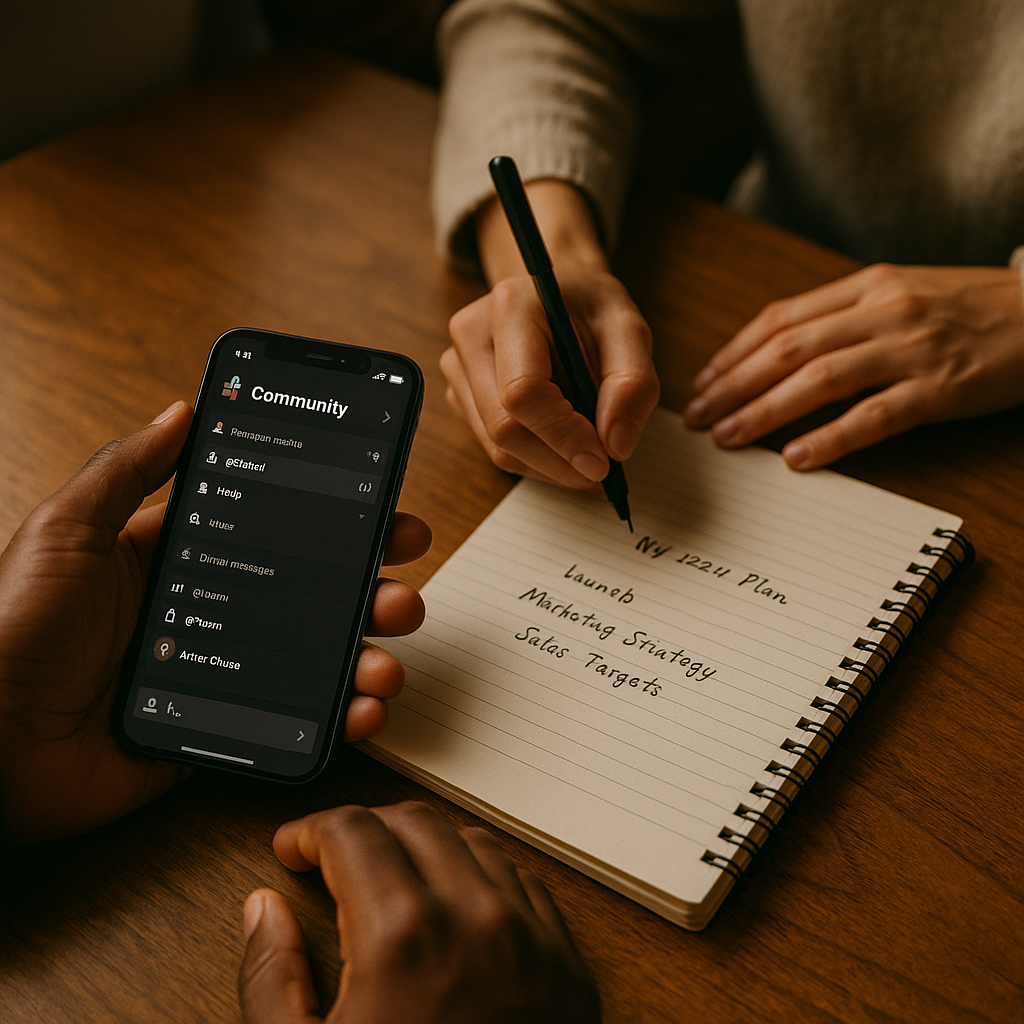
The honest answer on whether they deliver commercial value is: it depends entirely on the group composition and your own level of participation. A mastermind where you are the most successful member will not move you forward. One where you are consistently the least experienced person in the room probably will.
What the better-run paid groups offer that free alternatives rarely match is accountability. Structured formats with monthly calls, peer hot seats, and goal reporting create genuine pressure to follow through. That accountability mechanism is arguably the most commercially valuable part of the model, not the networking itself.
How to Find and Join the Right Group
Finding legitimate professional peer groups UK networking online requires a bit more effort than searching Google. The best communities do not advertise. They grow through referral. A few practical routes worth exploring:
- LinkedIn signals: Look at which communities your most commercially active connections are members of or reference. If three people you respect mention the same group, that is a reasonable signal.
- Slack community directories: Sites such as Slofile and Standuply index public and semi-public Slack communities by industry. Useful for finding sector-specific professional groups.
- Paid memberships with transparent criteria: Groups that clearly state who they are for, what the format involves, and what it costs are almost always better run than vague, credential-heavy landing pages.
- Industry events as a gateway: Ironically, attending one or two well-chosen conferences is still a reasonable route into private groups. Many invite-only communities recruit from event attendees who already demonstrate real commercial activity.
When evaluating any group, ask for a trial or a guest call before committing to annual fees. Any well-run community will accommodate this. If they will not, that tells you something useful about how they operate.
Building Your Own Private Community From Scratch
If the right group does not exist for your industry or stage, building one is more achievable than it sounds. The key is starting small and being ruthless about who you invite.
Begin with eight to twelve people you already have genuine professional respect for. Frame it explicitly as a peer group, not a networking group. The distinction matters to the people you want to attract. Set a clear purpose: monthly calls, a shared Slack or WhatsApp channel, and a loose but consistent agenda. Rotating facilitation keeps the load distributed and the format fresh.
Revenue from a private community is possible but should not be the initial objective. Charge only once you have demonstrated consistent value, a stable membership base, and a format people would genuinely miss if it disappeared. Groups that monetise too early tend to attract the wrong members and lose the candour that makes them valuable.
The Commercial Case for Making This a Priority
Professional peer groups UK networking online are not a soft benefit or a nice-to-have. For many business owners and senior professionals, they are becoming a primary source of commercial intelligence, warm introductions, and honest feedback that is genuinely difficult to get anywhere else.
The founders and consultants I have spoken with who are most active in these communities consistently report the same thing: the ROI is not from the group itself, it is from the quality of thinking and decision-making that improves when you are regularly in conversation with people operating at your level or above. That compound effect on judgement is hard to quantify but very easy to feel in the quality of your decisions twelve months later.
Traditional networking is not going away entirely. But it is being relegated to a supplementary role. The primary commercial relationships of the next decade are increasingly being built in smaller, quieter rooms, most of them online.
Frequently Asked Questions
What is a professional peer group and how does it differ from standard networking?
A professional peer group is a small, curated circle of business owners or senior professionals who meet regularly to share challenges, opportunities, and accountability. Unlike standard networking events, membership is usually restricted and the culture prioritises candid conversation over pitching or self-promotion.
How much do paid mastermind groups cost in the UK?
UK mastermind group costs vary widely, from around £300 to £500 per year for moderated Slack communities up to £10,000 to £20,000 annually for premium hybrid formats with in-person retreats. The price typically reflects the calibre of members and the level of facilitation rather than the volume of content provided.
How do I get invited to an invite-only Slack or WhatsApp business group?
Most invite-only groups grow through referral, so the most direct route is asking a trusted contact who is already a member. Engaging actively on LinkedIn, attending well-chosen industry events, and being visible in your sector also increases the likelihood of receiving organic invitations.
Are online peer groups as valuable as in-person masterminds?
For day-to-day peer support, deal flow, and accountability, online groups can match or exceed in-person formats because of their frequency and immediacy. High-touch paid masterminds that combine monthly online calls with quarterly in-person sessions tend to deliver the strongest results for most participants.
How do I start my own private business peer group?
Begin by identifying eight to twelve professionals you genuinely respect who are at a comparable stage of business. Set a clear format with a regular meeting cadence, use a platform such as Slack or WhatsApp for ongoing communication, and keep membership invite-only to maintain the quality of conversation and trust that makes these groups work.