
There is a particular kind of expensive lesson that most business owners know well: you commit capital, roll out a process, and only then discover the flaw that was obvious in hindsight. Digital twin technology is, at its core, a direct answer to that problem. It lets you build a precise virtual replica of a physical process, facility, or operational workflow, run it through simulated conditions, and stress-test decisions before a single pound leaves your account.
What was once the preserve of aerospace and defence contractors is now reaching UK manufacturing plants in the Midlands, logistics hubs across the North West, and even professional services firms in London. The price of entry has dropped substantially, and the practical upside is significant enough that mid-market operators can no longer afford to dismiss it as enterprise-only technology.
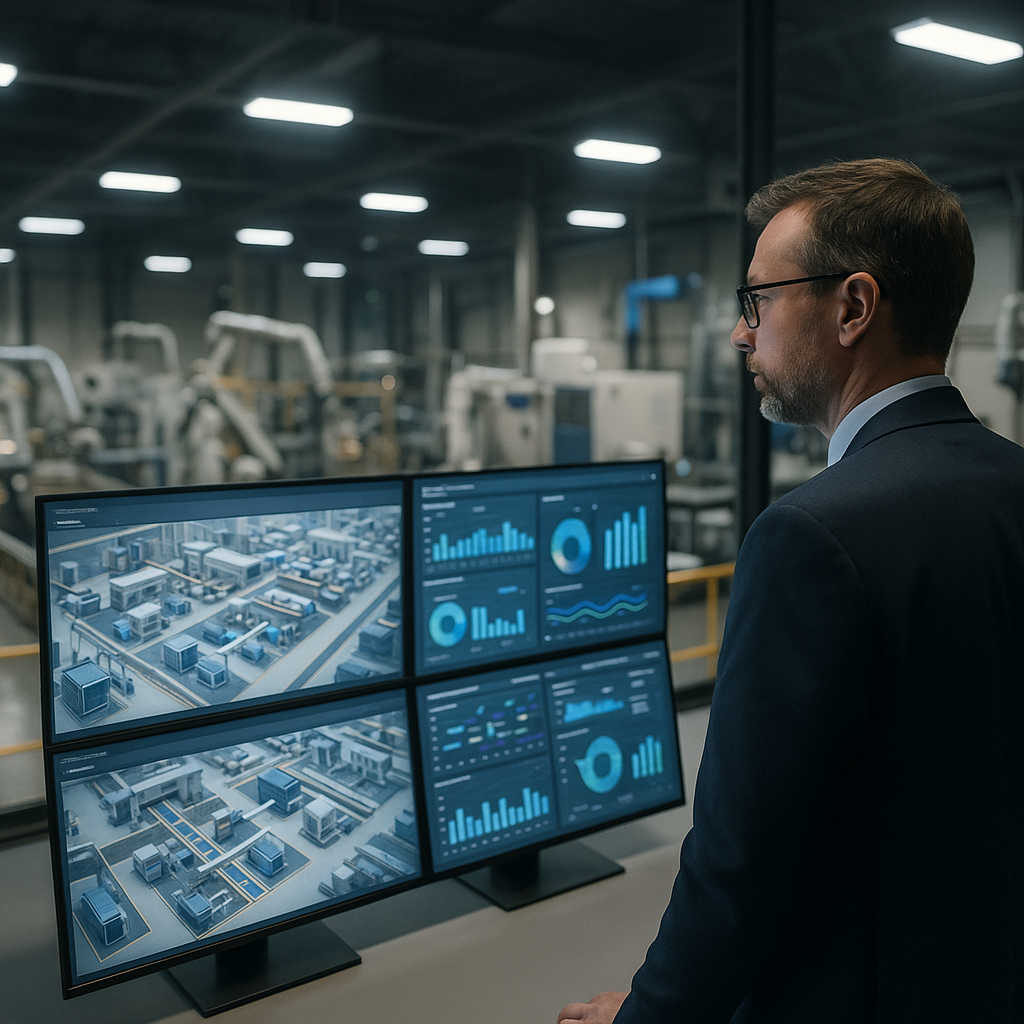
What digital twin technology actually means for a mid-sized business
The phrase gets misused often. A digital twin is not simply a 3D model or a dashboard of live metrics. It is a dynamic, data-fed simulation that mirrors a real-world system in something close to real time. When conditions change in the physical world, the twin updates. When you want to test a hypothetical change, you apply it to the twin first and observe what the model predicts.
A warehouse operator, for instance, might build a digital twin of their pick-and-pack floor. They can then simulate what happens when order volumes spike by 40 per cent, a conveyor goes offline, or a new fulfilment layout is introduced. Instead of reorganising the physical space and discovering the bottleneck three weeks later, they find it in the simulation on a Tuesday afternoon and never disrupt live operations at all.
The UK’s Manufacturing Technology Centre in Coventry has been actively supporting SMEs in this space, running pilot programmes specifically designed to help smaller manufacturers understand where simulation tools can generate measurable returns. Their published case work consistently shows that firms using simulation before capital deployment reduce rework costs by a meaningful margin, often between 15 and 30 per cent on specific projects.
Manufacturing use cases: where UK firms are seeing the clearest returns
UK manufacturing has been under sustained pressure: rising energy costs, supply chain fragility, and a persistent skills shortage have all forced operators to be more precise about where they invest. Digital twin technology fits that environment well, because it reduces the cost of being wrong.
One practical example is factory layout planning. When a Birmingham-based precision components manufacturer wants to reconfigure a production line to accommodate a new product family, traditionally they would hire a consultant, sketch a floor plan, and then implement it with significant disruption. With a digital twin, they can model five different layouts, simulate material flow and labour movement through each, and choose the option that maximises throughput before a single machine is moved.
Energy modelling is another area attracting serious interest. With industrial energy costs still elevated, firms are using digital twins to simulate the effect of operational changes on consumption. Running a shift pattern differently, adjusting equipment sequences, or identifying idle load can all be tested virtually. The carbon reporting obligations coming down the line from HMRC and Companies House are also nudging businesses to get better data on operational efficiency, and digital simulation supports exactly that kind of audit trail.

Logistics and supply chain: testing resilience without the risk
For logistics operators, the appeal is slightly different. The question is not usually about facility layout; it is about decision-making under uncertainty. What happens to your delivery network if a key supplier is delayed by a fortnight? What does rerouting through a different regional hub do to your cost per parcel and your on-time delivery rate?
Answers to those questions used to come from painful experience. Now they can come from a simulation run over a weekend. Companies including Wincanton and DHL’s UK operations have invested in simulation and digital modelling capabilities precisely because the cost of getting a network decision wrong at scale is too high to accept without prior testing.
For smaller logistics firms, cloud-based simulation platforms have made this more accessible. Tools built on platforms such as AnyLogic or Simio can be configured without a software engineering team, and several UK resellers now offer managed setups for SMEs at price points that were unimaginable five years ago. The Innovate UK funding guidance lists several active streams that specifically support digital adoption in logistics and supply chain operations.
Professional services: the less obvious application
Manufacturing and logistics are the obvious homes for digital twins, but professional services firms are starting to find genuine utility in the concept, even if the implementation looks different. A consultancy or law firm does not have a factory floor, but it does have workflows, capacity constraints, and resource allocation decisions that can be modelled.
A mid-sized accountancy practice, for example, might build a workflow twin of their tax return processing operation. They can model what happens to turnaround times if they onboard 20 per cent more clients in Q1, or if two senior managers are simultaneously on annual leave during the January deadline crunch. The simulation does not need to be complex to be useful; it just needs to be grounded in real operational data.
This kind of structured operational thinking also connects to broader conversations about how businesses use technology and data to make better decisions. Some firms approaching this have drawn inspiration from adjacent fields, including the way digital activism has demonstrated that well-modelled, data-driven approaches can produce outcomes that pure intuition consistently misses.
What stops UK SMEs from adopting digital twin technology faster
The honest answer is a mix of cost perception, skills gaps, and organisational inertia. Many business owners still assume digital twin projects require a dedicated data science team and a six-figure budget. That was true in 2015. It is far less true now.
The more persistent barrier is data quality. A digital twin is only as accurate as the operational data feeding it. Firms that have never systematically captured process times, failure rates, or resource utilisation will struggle to build a meaningful model without first doing some groundwork. That groundwork, though, has its own value: the process of preparing data for a simulation often surfaces operational blind spots that businesses did not know they had.
There is also a change management dimension. Senior teams who have built processes on experience and instinct can be resistant to having a model tell them their assumptions are wrong. The firms getting the most out of digital twin technology tend to be those where leadership has actively championed the approach rather than simply funding it and stepping back.
Getting started without overcommitting
The most sensible entry point for most UK mid-market firms is a bounded pilot. Pick one process that is costing you money or causing operational friction, and model only that. A single production line, one logistics route, one client service workflow. The goal is not to build a complete operational twin in year one; it is to demonstrate enough value from a small simulation that the business case for wider adoption becomes self-evident.
Several UK universities with manufacturing and operations research departments, including Loughborough, Cranfield, and Strathclyde, offer collaborative project programmes that give SMEs access to simulation expertise at reduced cost. These partnerships are underused and worth investigating before committing to a commercial software contract.
The competitive pressure to make better operational decisions faster is not going away. Digital twin technology gives UK businesses a structured, evidence-based way to do exactly that, and the window for treating it as someone else’s problem is narrowing.